


From entertainment and marketing to healthcare and finance, generative AI is no longer a futuristic concept. AI is here, it’s powerful, and it’s prolific. Tools like ChatGPT, Midjourney, and DALL•E are used to write code, draft legal documents, generate medical insights, and even craft marketing campaigns. Yet its rise delivers not just innovation—it ushers in an influx of fresh data privacy concerns.
Generative AI thrives on data. The very fuel that powers its predictions, responses, and creations is massive datasets. Many of these datasets include personal, sensitive, or even confidential information. The sheer scale and speed at which these tools operate have reshaped what individuals, organizations, and regulators expect when it comes to data privacy and security. In this brave new world, privacy is no longer a check-the-box exercise. It must be a proactive, strategic imperative.
How generative AI impacts data privacy and AI privacy risks
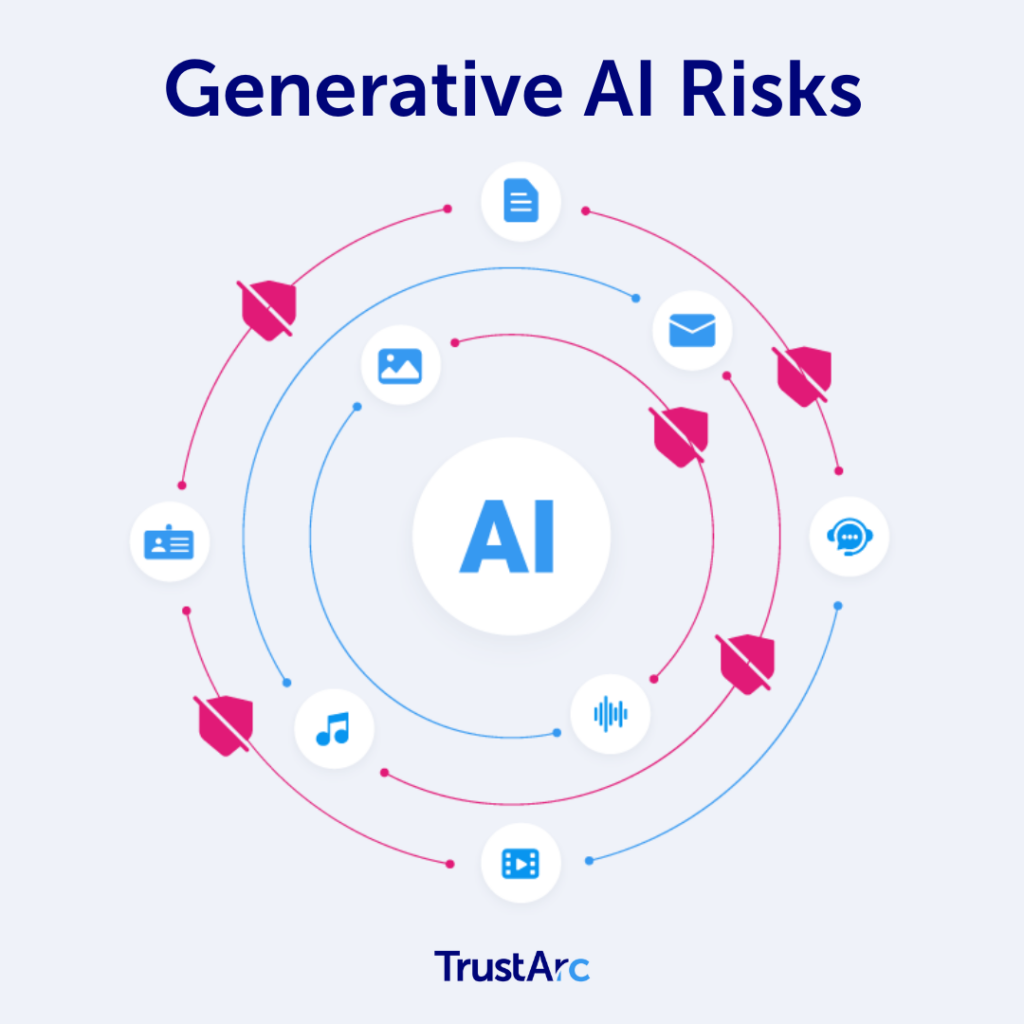
Changing data privacy expectations in generative AI
Generative AI systems are trained on large-scale datasets that may include everything from public internet content to user-generated data. This creates a seismic shift in privacy expectations:
- Unintentional exposure: AI models might inadvertently regurgitate personal data on which they were trained.
- Purpose drift: Data collected for one reason might be used in entirely different ways through generative models.
- Perpetual processing: AI systems often retain information in ways that make it difficult to trace or erase.
Why privacy must be a priority in generative AI adoption
To mitigate risk and maintain trust, organizations must treat data privacy not as an afterthought but as a foundational pillar in AI adoption. This includes integrating privacy by design principles, conducting AI-specific privacy impact assessments, and ensuring transparency in how AI systems use data.
Supporting this shift, the 2024 TrustArc Global Privacy Benchmarks Report found that AI remains the top privacy challenge for organizations worldwide for the second consecutive year. Additionally, 70% of companies identified AI as an important or very important privacy concern, underscoring how AI-related risks are shaping strategic data privacy priorities.
TrustArc is at the forefront of this evolving landscape. With deep expertise in AI risk management, privacy governance, and regulatory compliance, TrustArc offers the frameworks and tools companies need to navigate the privacy complexities of generative AI confidently. The TrustArc Platform strengthens this approach by giving organizations a centralized privacy management platform to manage AI risks, track compliance obligations, and embed privacy safeguards across their AI workflows.
What is generative AI and why it matters for data privacy?
Generative AI refers to a branch of artificial intelligence designed not just to interpret the world but to reimagine it. Unlike conventional AI models that categorize, forecast, or analyze, generative AI systems are creators. They synthesize new content based on training data, which includes text that mimics human tone and logic, images that could pass for digital paintings, audio clips that echo familiar voices, and videos that blur the line between simulation and reality.
These models work by recognizing patterns in enormous datasets and using those patterns to generate content that feels original, contextually appropriate, and often uncanny in its realism. What makes generative AI so distinct is its creative output. AI doesn’t just choose from existing answers; it fabricates new ones that didn’t exist before, all based on learned patterns.
Take OpenAI’s GPT-4, for example, which can draft compelling essays, summarize dense legalese, and even help engineers write efficient code. Tools like DALL•E and Midjourney transform written prompts into photorealistic or stylized artwork. Meanwhile, video generators like Sora push the envelope even further by creating cinematic-quality footage from mere text descriptions. It’s the kind of technology that once belonged to science fiction, and now shapes science, business, and beyond.
The power of generative AI isn’t just theoretical. AI is already transforming core industries in tangible ways. In healthcare, organizations use AI to create synthetic medical datasets that preserve patient privacy while supporting robust clinical research and model training. Financial institutions automate the generation of compliance reports, fraud summaries, and even personalized investment advice—enhancing efficiency and regulatory alignment.
In marketing, generative AI can craft tailored email campaigns, blog drafts, or even product descriptions for diverse customer segments at scale and in seconds. And in customer service, AI chatbots now go far beyond scripted responses. Trained on customer interaction history and behavior, they deliver dynamic, contextual, and natural-sounding support 24/7. These examples highlight how generative AI is augmenting existing workflows and reshaping what’s possible across the board.
AI privacy risks in the age of generative AI
While the benefits of generative AI are compelling, the privacy risks it introduces are equally significant. These models are only as safe as the data that feeds them. And often, that data includes personal, proprietary, or otherwise sensitive information. When organizations overlook privacy safeguards, they risk unintended exposure, misuse, or even generation of inappropriate content. Here are three key areas of concern:
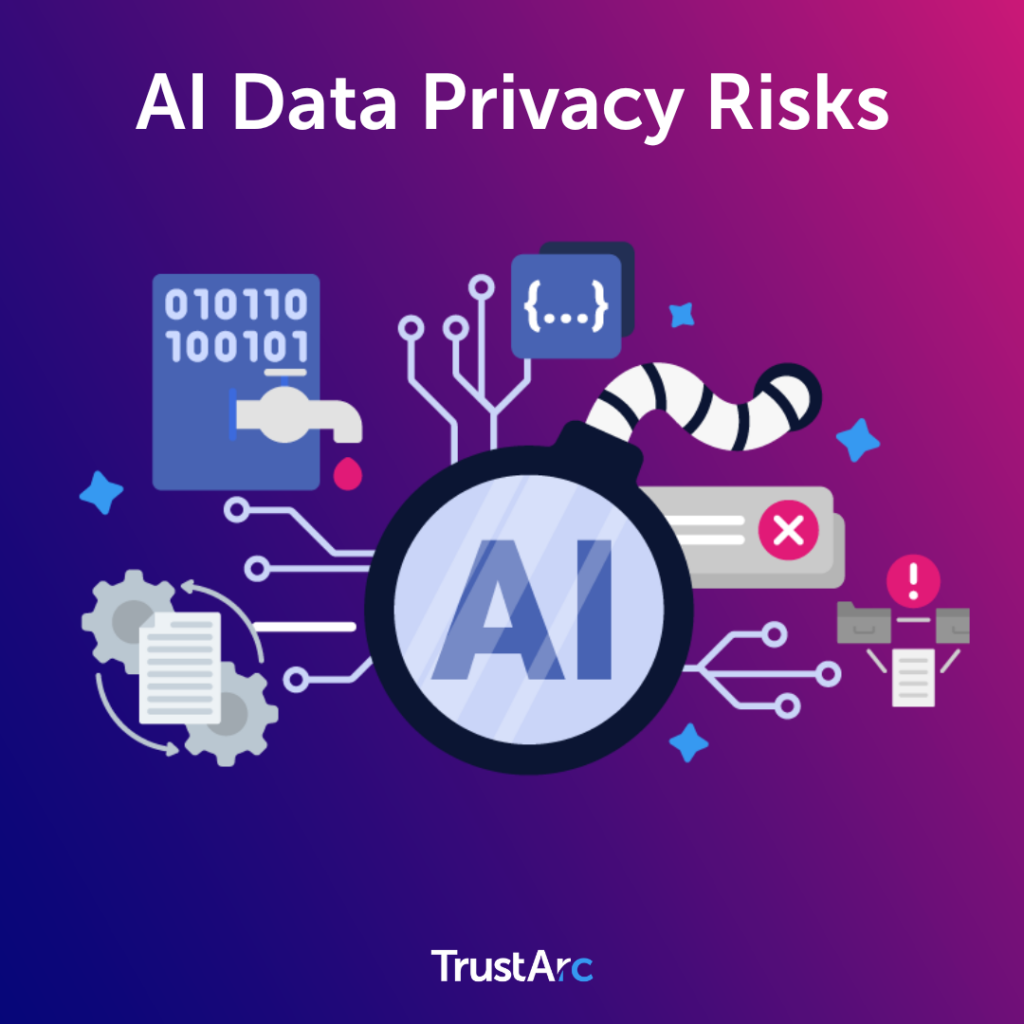
Data leakage risks in generative AI models
Generative models can unintentionally memorize and repeat sensitive data. This risk is amplified when models are fine-tuned on proprietary or user-submitted content.
Unauthorized data use and AI privacy risks
If data used to train an AI model was collected without explicit consent for that purpose, organizations risk privacy violations and regulatory noncompliance.
Generation of sensitive or high-risk AI content
Some generative AI tools may create outputs that contain personal, discriminatory, or misleading information (intentionally or not) that triggers ethical and legal red flags.
Legal and ethical considerations for generative AI data privacy
As generative AI tools become more deeply embedded in everyday business operations, the legal and ethical stakes are rising. Regulatory frameworks are tightening, and stakeholders are demanding clearer accountability. Whether it’s ensuring informed consent, mitigating algorithmic bias, or defining liability when things go wrong, organizations must proactively address these challenges to avoid reputational and legal fallout.
Privacy laws and compliance and generative AI data privacy
Regulations like the GDPR, CCPA, and the emerging EU AI Act require organizations to:
- Obtain clear consent for data use
- Minimize data collection and retention
- Conduct Data Protection Impact Assessments (DPIAs) for high-risk AI applications
Ethical AI usage and responsible AI governance
Responsible AI requires fairness, transparency, and explainability. Organizations must:
- Avoid algorithmic bias
- Ensure human oversight
- Promote accountability in AI-driven decisions
Accountability and liability in AI privacy risks
Who is responsible when generative AI causes harm? Under regulations like the Colorado AI Act, developers and deployers of high-risk AI systems may be liable. This puts the onus on organizations to vet their tools, assess risk, and document mitigation measures.

Accountable AI, Build for Real-World Governance and Privacy
Bridge the gap between innovation and responsibility. Learn how to embed transparency, fairness, and privacy into every stage of your AI lifecycle with practical insights from industry experts.
Get the readiness guide
Executive Oversight for Responsible AI Governance
Empower your board and executive team to lead with confidence. This strategic guide helps decision-makers govern AI adoption while staying ahead of emerging privacy risks and regulations.
Explore the governance guideHow to use generative AI responsibly and strengthen AI privacy
Responsible use of generative AI starts with understanding that privacy is more than a feature, privacy is a foundational requirement. Whether you’re building, buying, or simply using AI tools, there are critical steps each stakeholder must take to reduce risk and promote trust.
For businesses, responsible AI adoption begins with governance. Companies must clarify how AI tools are selected, used, and monitored. Rather than relying on informal or ad hoc use, businesses should embed privacy principles into every phase of the AI lifecycle and require regular risk assessments that align with widely recognized standards like the NIST AI RMF or the EU AI Act.
Developers play a unique role in ensuring privacy is engineered into AI systems from the ground up. Following privacy by design principles, they should prioritize minimizing data exposure. This includes using synthetic or anonymized data for model training and validation and carefully documenting how models behave, how they process inputs, and what they generate. Clear logs and audit trails go a long way in proving compliance and spotting issues before they escalate.
Awareness is the best defense for individual users. Be cautious when interacting with generative AI tools, especially if you’re inputting sensitive personal or business information. Always look for providers who publish clear privacy policies and offer robust safeguards around data storage, sharing, and retention. Just because a tool is convenient doesn’t mean it’s compliant.
By aligning people, processes, and technology, each group can contribute to a more secure and privacy-respecting AI ecosystem. Organizations can also benefit from using a centralized privacy management platform to help coordinate assessments, streamline AI governance workflows, and maintain clearer oversight across the AI lifecycle.
Safeguarding tips for generative AI data privacy protection
Data anonymization for generative AI data privacy
Strip personal identifiers before using data to train AI systems. This reduces the risk of reidentification while preserving data utility.
Encryption strategies to reduce AI privacy risks
Encrypt data at rest and in transit to prevent unauthorized access, especially when interacting with third-party AI APIs or cloud services.
Access control measures for responsible AI governance
Use role-based access controls to limit who can interact with or modify AI models, training data, and outputs. Monitor usage to detect anomalies.
The rising call for generative AI data privacy and transparency
Growing public awareness of AI privacy risks
People are more aware than ever that their data might be training the next viral chatbot. Consumers increasingly expect transparency, choice, and control over how their data is used.
A 2023 Pew Research Center survey found that 90% of Americans have heard at least a little about artificial intelligence, with one-third reporting substantial awareness. Similarly, the IAPP Privacy and Consumer Trust Report 2023 revealed that 57% of global consumers view AI’s role in collecting and processing personal data as a significant privacy threat. These insights underscore the growing public demand for visibility, accountability, and ethical safeguards in how organizations use personal data to train AI systems.
Regulatory pressure driving responsible AI governance
Governments worldwide are racing to establish new rules that can keep pace with the rapid advancement of AI. The EU AI Act, widely seen as a global bellwether, introduces a tiered risk-based classification system that requires stringent privacy, transparency, and oversight measures for high-risk applications.
In Canada, the proposed Artificial Intelligence and Data Act (AIDA) is laying the groundwork for responsible AI governance through mandatory impact assessments and new compliance obligations.
Meanwhile, in the United States, state-level legislation, such as California’s CCPA and Colorado’s AI Act, is expanding the scope of privacy protection, algorithmic accountability, and consent requirements.
Together, these initiatives signal a global regulatory shift: AI is no longer exempt from scrutiny, and businesses must be ready to prove compliance or face steep legal, financial, and reputational consequences.
Industry trends shaping generative AI data privacy
The industry is also responding with a strategic pivot toward privacy-first innovation. Organizations are increasingly adopting privacy-enhancing technologies (PETs) to reduce the risks associated with sharing or processing sensitive data. These solutions (like federated learning or differential privacy) help businesses train AI models while preserving user anonymity and minimizing direct data exposure to enable secure, compliant AI training and deployment.
At the same time, frameworks prioritizing transparency, explainability, and data minimization—like NIST’s AI Risk Management Framework and the OECD AI Principles—are gaining traction as businesses look to embed trust and accountability into their AI operations.
These trends reflect a broader movement: organizations are no longer asking if they should care about privacy in AI. Now, they’re asking how to scale it effectively and sustainably across the enterprise.
How TrustArc supports responsible AI governance and privacy risk management
TrustArc offers tailored solutions to support responsible AI deployment across industries:
- AI Risk Assessments that align with NIST and EU AI Act standards
- Training and awareness checklists to educate teams on legal, ethical, and operational AI use
- Procurement guidance to vet and manage third-party AI systems
- PrivacyCentral to manage evolving compliance requirements across global frameworks
TrustArc empowers privacy, compliance, and security professionals to confidently manage the complex data privacy risks that generative AI introduces.
Why addressing AI privacy risks requires more than good intentions
Generative AI is redefining what’s possible and what’s risky. As the technology accelerates, so do privacy implications. From unintentional data exposure to regulatory noncompliance, the stakes are high.
By embracing responsible AI practices, aligning with regulatory guidance, and partnering with experts like TrustArc, organizations can turn risk into resilience and innovation into advantage. A dedicated privacy management platform like TrustArc can also help operationalize these efforts by centralizing assessments, governance workflows, and ongoing monitoring to keep AI programs aligned with evolving regulations.

AI Compliance, One Step at a Time
Navigate the evolving AI landscape without the guesswork. This guide walks you through risk assessments, regulatory requirements, and best practices for responsible AI deployment.
Download the compliance guide
AI Risk? Meet Your Mitigation Plan
Get ahead of AI-driven risk with tools built for privacy pros. TrustArc’s AI Risk solution helps you operationalize compliance across every stage of the AI lifecycle from assessments to automation.
Tackle AI risk today