Skip to Main Content
Main Menu
Data Mapping & Risk Manager

Manage risk with automated data mapping software

Save time and reduce privacy risk with automated data flow mapping, risk analysis, and intelligent assessment recommendations for on-demand compliance reporting and audit trails.

Data discovery and ROPA Management with Data Mapping Tools

If you collect personal data as part of your business, you need a clear, current record of how it moves through your systems and vendors, which activities create elevated risk, and where deeper review may be required. You also need to maintain records of processing activities (ROPAs) under Article 30 of the GDPR. TrustArc’s approach is to turn that inventory from a static spreadsheet into a living record that supports reporting, oversight, and privacy-by-design decisions.

Third-Party Vendor Risk Management & Data Risk Mapping Solutions

Managing third-party privacy risk is difficult because the real question is not only who the vendor is. It is what data they handle, where it goes, how it is used, and what obligations or risks follow. TrustArc’s benchmark data shows the stakes: more than 10% of companies report losing trade partners after uncovering data security risks in their vendor ecosystem. TrustArc helps teams connect vendor records to the systems, business processes, and data flows that create real privacy exposure.

Source: TrustArc Benchmarks Report

Automated Data Mapping Software for Privacy Ops

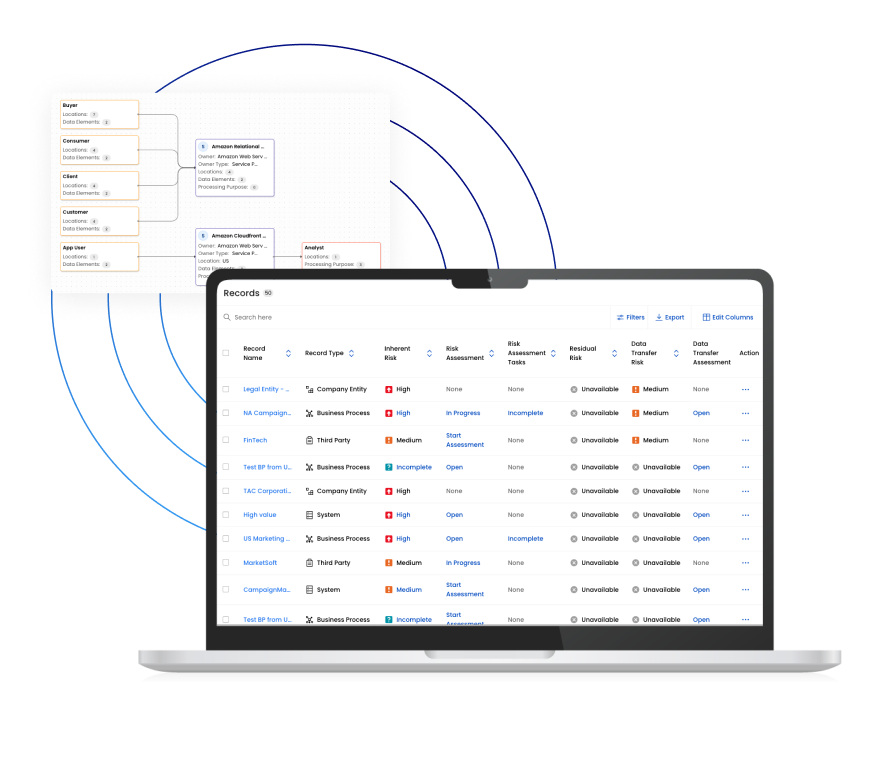
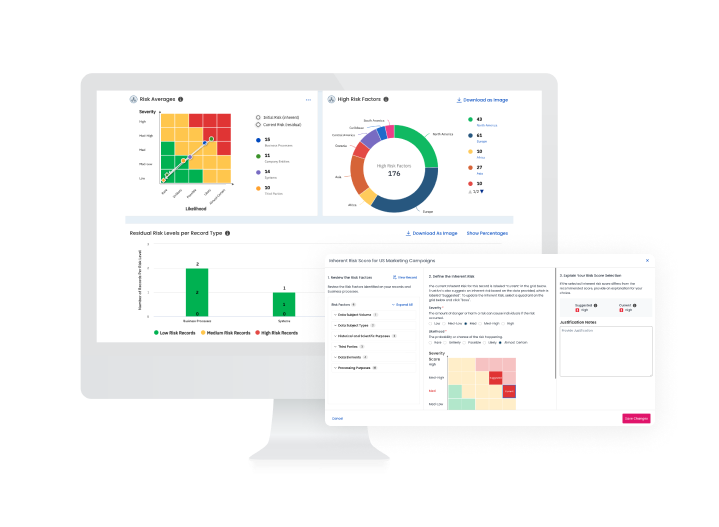
TrustArc’s Data Mapping & Risk Manager helps privacy teams answer the questions that slow them down: what data they process, where it flows, and where the risk is. It uses automated data mapping and AI-assisted record creation to build a living inventory across systems, vendors, and business processes, map data flows, and calculate inherent risk. When risk is high, it recommends the next step by triggering follow-up assessments in Assessment Manager, so teams can move from visibility to action.

ROPA Records, Built in Seconds

Tired of endless copy-pasting to get your ROPAs ready? Let AI handle the heavy lifting. With automated field population, you’ll start with 80% of your inventory already done—no guesswork, no repetitive tasks.

From processing purposes to hosting locations, data elements, and more, our AI doesn’t just fill in the blanks—it flags gaps and suggests fixes, making your records more complete, faster.

Focus on what matters: reviewing and refining, not creating from scratch.

Automated Data Mapping Platform for Privacy Operations & Compliance

TrustArc provides a powerful data mapping platform that simplifies the data mapping process across multiple systems and complex data environments. As part of TrustArc’s broader, automated data mapping solutions help organizations map data flows, integrate diverse data sources, and support enterprise data management while ensuring data privacy compliance.
  • Automated Data Inventory Creation

    Leverage automated processes or integrations to discover and map your data and data flows.

  • Automated Data Flow Mapping

    Support your GDPR Article 30 requirements with automated data flow mapping and structured records that make processing activities easier to document, update, and report on demand.

  • Automated Data Risk Analysis & Scoring

    Automatically identify inherent privacy risk across processing activities, cross-border data transfers, and AI-related use cases. TrustArc’s proprietary risk model is based on 130+ global laws and standards, helping teams focus attention where deeper review is most likely needed.

  • Automated Remediation & Privacy Risk Management

    Quickly identify high-risk records and move to the right next step. TrustArc can recommend or trigger PIAs, DPIAs, TIAs, vendor assessments, and AI assessments in Assessment Manager, where teams complete the workflow, assign remediation tasks, and track follow-up work.

  • Third-Party Vendor Risk Management

    Capture vendor risk in context by linking vendors to the systems, business processes, and data flows they support. That gives privacy teams a more useful view of exposure than a standalone vendor checklist.

  • Data Discovery & Integration

    Automate how discovery data flows into your privacy program. TrustArc connects discovery inputs from integrations and partner tools into a structured data inventory that maps systems, vendors, and business processes. Instead of leaving discovery data isolated, it is linked to processing activities, data flows, and regulatory context so you can understand what the data means, where risk sits, and what action is required.

With TrustArc, the ability to manage data subject requests in combination with data inventory and risk assessments is key.

– Director of Privacy and Cybersecurity

With TrustArc we are kept aware of necessary risks, roadblocks, and best practices related to our web presence, data handling, etc from a global perspective. In an industry (Medical & Industrial Equipment) which is already managing too many mission critical RA/QA/IT tasks, this light in a gray area really delivers.

– Michael L., Marketing Coordinator

For us, TrustArc has been a savior. Our data privacy administration, which was previously a difficult and time-consuming procedure, has been simplified by the program.

– Sean S., CFO

TrustArc is perfect for tracking your company’s data inventory.

– Sarp K., G2 Review

Data Inventory Hub is a game-changer – it’s like a map that shows you how data moves around in your company. Super helpful for knowing and jotting down everything about data processing.

– Tim C., G2 Review

    It’s a big job — TrustArc can help

    Map your data, automate risk identification and remediation with TrustArc’s Data Mapping & Risk Manager solution.

    What Automated Data Mapping Actually Improves


    Privacy job What TrustArc automates Why it matters
    Data inventory creation Uses AI-assisted record creation, bulk record creation, Record Exchange, business process forms, and integrations to create and update records for systems, vendors, affiliates, and business processes. Reduces manual setup and makes it easier to build a living inventory instead of maintaining static spreadsheets.
    Data flow mapping Generates interactive data flow maps, transfer maps, and relationship views across business processes, systems, vendors, and entities. Gives privacy teams a clearer picture of how personal data moves, where it is shared, and where obligations or risk may sit.
    Discovery-to-inventory workflows Ingests inputs from website-based third-party discovery, integrations, and third-party discovery tools into inventory and risk workflows. TrustArc also supports AI-assisted record creation and Record Exchange to accelerate inventory population. Discovery data becomes useful only when it is linked to processing context, ownership, and privacy obligations.
    Risk calculation Automatically calculates data processing, data transfer, and AI risk across records based on factors such as data sensitivity, processing purpose, geography, and AI usage. Helps teams identify which activities need deeper review instead of treating all records as equal.
    Assessment handoff Recommends assessments based on calculated risk and supports linked assessments so control effectiveness can inform residual risk. Assessment execution happens in Assessment Manager. Connects risk identification to follow-up action without pretending the inventory itself is the full remediation workflow.
    Article 30 reporting Produces configurable GDPR Article 30 reports, including controller and processor outputs, with data flow and map options. Turns inventory and mapping work into regulator-ready documentation when teams need to demonstrate compliance.
    Vendor and third-party context Tracks third parties, links them to business processes and systems, supports role management, and surfaces third-party risk in context. Gives a more useful privacy view than a flat vendor list because risk depends on what data is involved and how it is processed.
    Ongoing upkeep Supports revalidation schedules, notifications, audit trails, configurable exports, filtering, and record updates through integrations. Helps teams keep records current as systems, vendors, and processing activities change.

    Data Mapping Software FAQs

    • What is data mapping software?

      Data mapping software is a tool that helps organizations map data between systems, track data flows, and manage personal and sensitive data across multiple environments. It supports data integration, data governance, and data privacy compliance.

    • What is automated data mapping?

      Automated data mapping uses AI, reusable records, discovery inputs, integrations, and workflows to reduce manual record creation and make inventories easier to keep current over time.

    • Why is data mapping important for data privacy compliance?

      Because you cannot manage privacy obligations well if you do not know what data you collect, why you process it, where it goes, and who touches it. GDPR Article 30 requires records of processing activities, and that same inventory supports audits, assessments, and responses to regulators.

    • How does a data mapping tool help manage data flows?

      A data mapping tool tracks how data moves between systems, applications, and third-party services. It provides visibility into data pipelines, data transformation, and data integration tasks across complex data environments.

    • What is a ROPA and how does data mapping support it?

      A Record of Processing Activities (ROPA) is required under GDPR and documents how personal data is processed. Data mapping software automates ROPA creation by capturing data elements, data sources, and processing activities.

    • Can data mapping software help with third-party risk management?

      Yes, strong data mapping solutions help teams understand not just which vendors exist, but what data they process, how data flows through them, and whether that activity should trigger a deeper assessment. That connection between inventory and risk analysis is what turns vendor lists into actionable oversight.

    • What are the key features of modern data mapping tools?

      The most effective data mapping tools include AI-assisted record creation, reusable record libraries, discovery inputs, data flow mapping, risk analysis, vendor and system records, assessment recommendations, and on-demand reporting. The difference between basic and advanced solutions often comes down to how well these features work together rather than whether they exist individually.

    • How does automated data mapping improve data accuracy?

      It reduces repetitive manual entry, standardizes how records are created, and makes it easier to keep records updated as systems, vendors, and uses change. The best approach still keeps people in the loop to validate output — automation handles the volume, humans handle the judgment.

    • Can data mapping software integrate with multiple systems?

      Yes, and integration depth matters. Platforms that sync privacy workflows with business systems and pull useful upstream data into inventory and assessment workflows save teams from maintaining parallel records manually. The broader the integration library, the more complete your data picture becomes.

    • How does data mapping support enterprise data management?

      Data mapping supports enterprise data management by giving context to data. It shows not just where data lives, but why it is processed, how it moves across systems and vendors, and what obligations follow. That context is what makes data usable for governance, risk decisions, and compliance. Without it, data stays visible but not actionable.

    Back to Top