Skip to Main Content
Main Menu
Consent & Consumer Rights

Website Monitoring Manager

Identify and monitor cookies, trackers, and website behavior to deliver a secure digital user experience

Deliver a secure digital experience

Using cookies and other tracking technologies enable companies to provide an enhanced online experience for website visitors. However, these technologies also introduce privacy compliance risks along with challenges of visibility into the dozens or hundreds of third-party trackers on a website.

TrustArc Website Monitoring Manager is the most mature and comprehensive website monitoring solution to identify compliance risk, conduct cookie audits, and manage trackers for consent. With our solution, gain a comprehensive understanding of your website’s tracking behavior and deliver a secure and faster digital user experience.

  • Understand website's tracking activity

    Schedule deep website scans, including subpages and behind login pages, to detect trackers across different web properties and understand their impact on website performance

  • Automate cookie and tracker categorization

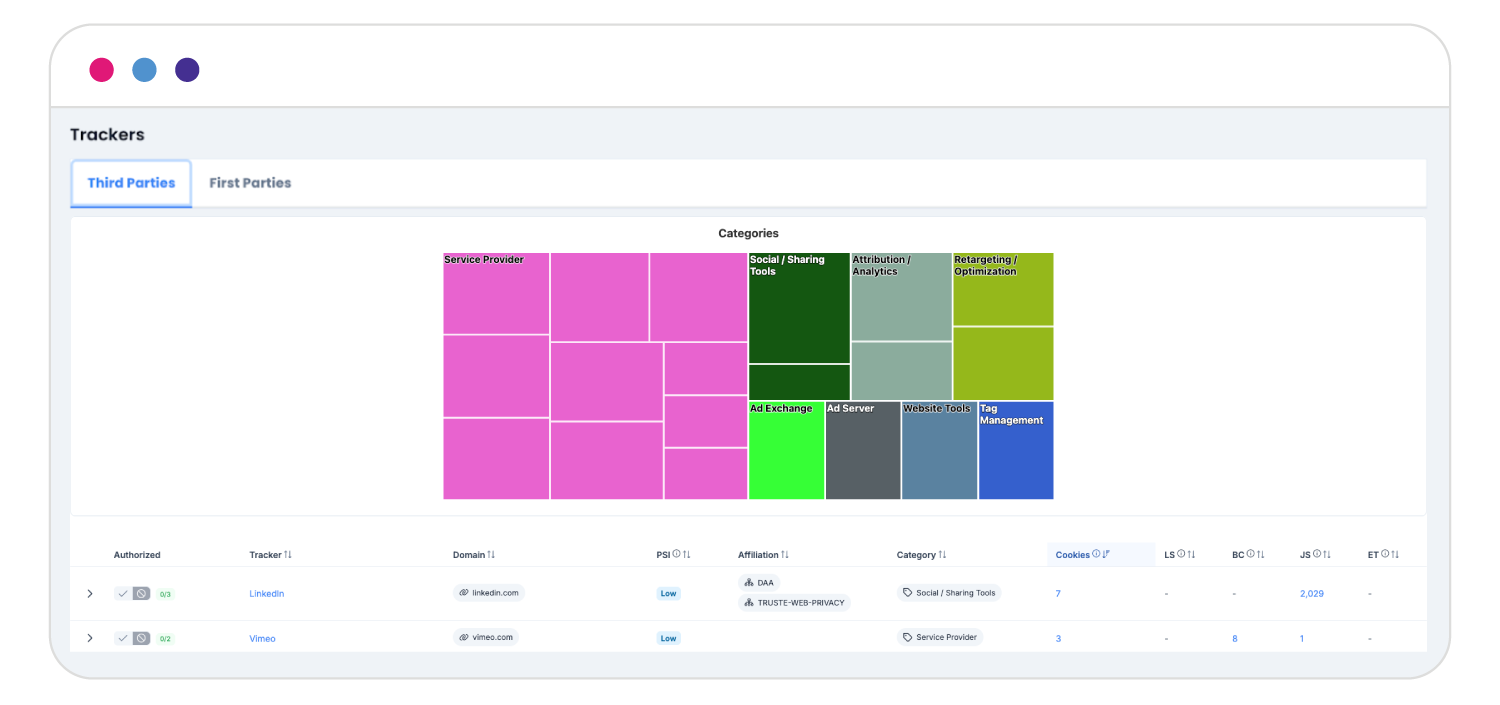
    Identify and organize trackers into predefined categories including Required, Functional, and Advertising, or create custom categories that suit your individual business needs

  • Analyze tracker and risk analysis

    Analyze detected trackers against an extensive tracker database and easily vet which vendors are at high privacy risk with the TrustArc proprietary Privacy Sensitivity Index (PSI)

  • Generate comprehensive reporting

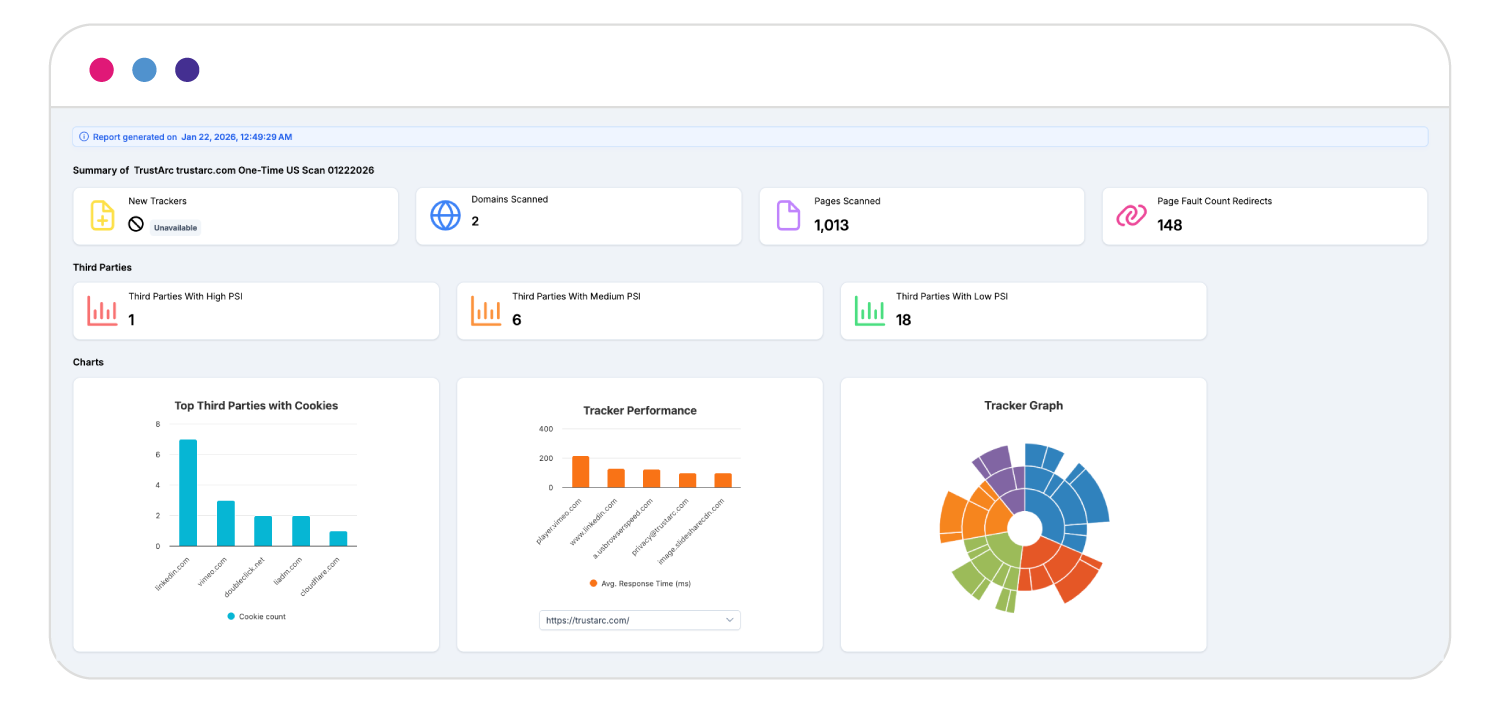
    Share website data with your team and analyze tracker details including type, frequency of use, and metadata to make informed compliance decisions

Reporting dashboard

Tracker categories

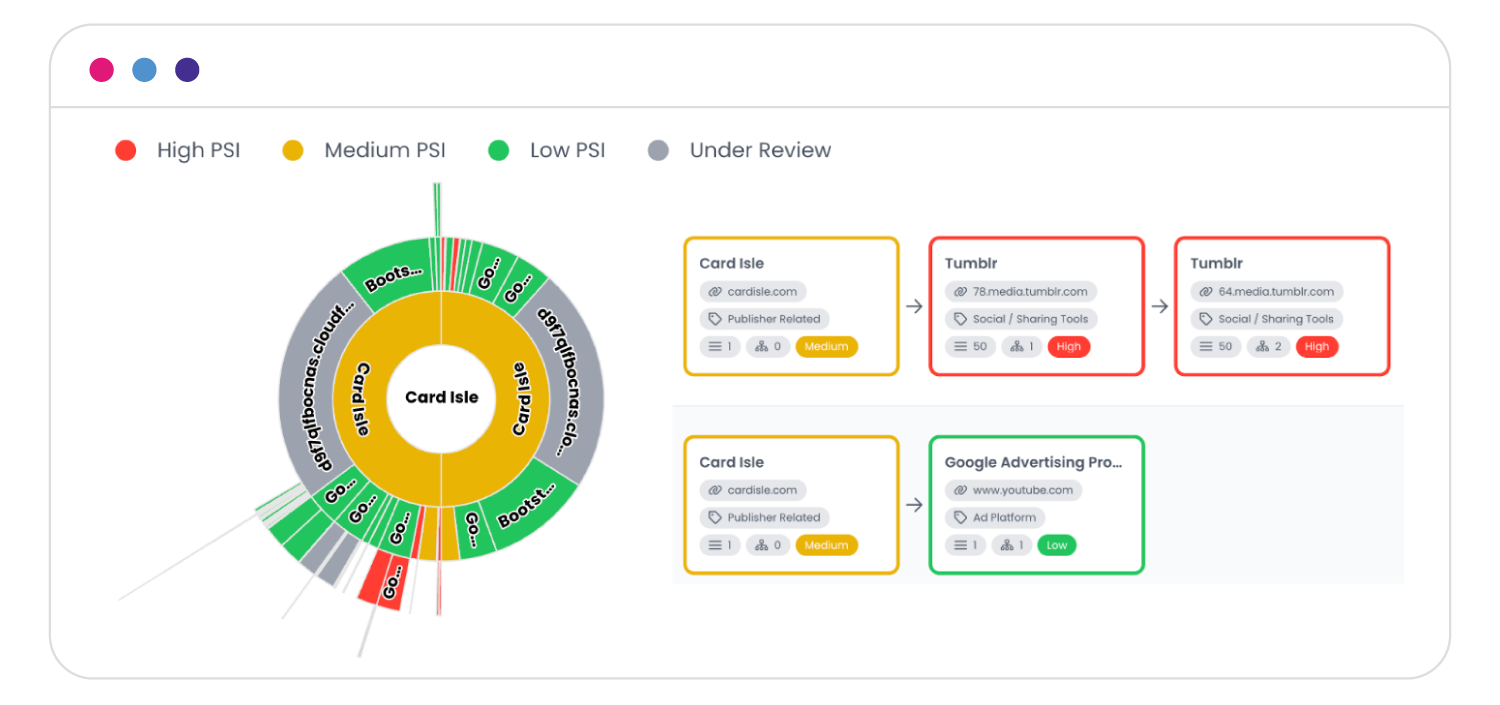
Tracker resource chain analysis

Understand your website’s tracking activity

  • Visibility into who can access your website data

    Gain insight into where third-party trackers come from and what tracking technologies they use to collect the data through tracker resource chain analysis.

  • CCPA support

    Determines the trackers that should be categorized as service providers and third-parties for CCPA purposes.

  • GDPR support

    Addresses guidance from the Information Commissioner’s Office (ICO) and Commission nationale de l’informatique et des libertés (French CNIL).

  • Integrated with TrustArc Cookie Consent Manager

    Easily implement a consent mechanism and meet GDPR, ePrivacy, and CCPA consent requirements.

Website Monitoring FAQs

  • What is a website monitoring tool and why do I need one for privacy compliance?

    A website monitoring tool automatically scans your website to detect and catalog all cookies, trackers, and third-party technologies collecting data from your visitors. Regulations like GDPR, ePrivacy, and CCPA require organizations to have accurate, up-to-date visibility into their tracking activity before they can obtain valid consent.

    An organization’s website is the front door to their privacy program and the most noticeable if there is a deficiency. In terms of enforcement, the UK ICO expanded its cookie compliance sweep to the top 1,000 most-visited UK websites in 2025, issuing letters to non-compliant organizations with short remediation windows of just a few weeks. Without continuous automated monitoring, organizations have no reliable way to know whether their consent configurations are actually working as intended.

  • What is a cookie audit and how often should one be conducted?

    A cookie audit is a systematic scan of your website to identify every cookie and tracker being set on visitors’ devices, document what each one does, and verify that your consent notices accurately reflect that activity. Regulators including the French CNIL and UK ICO actively inspect websites and expect organizations to maintain accurate, current records of their tracking technologies.

    As a general rule, audits should run at least quarterly, and any time a significant site update, new vendor integration, or marketing campaign change is deployed. Enforcement cases demonstrate why ongoing cadence matters. For example, the CNIL fined Condé Nast €750,000 after audits in both 2023 and 2025 for consent-based cookies still being placed before users made any choice. TrustArc Website Monitoring Manager supports visibility and reporting of your trackers and compliance.

  • How does TrustArc Website Monitoring Manager integrate with a cookie consent banner?

    TrustArc Website Monitoring Manager is natively integrated with the TrustArc Cookie Consent Manager, so the tracker data discovered during scans flows directly into your consent configuration. This means newly detected trackers can be categorized and mapped to the appropriate consent categories without duplicating work across separate solutions.

  • Can website monitoring tools detect trackers that fire without user consent?

    Yes. Identifying pre-consent firing is one of the most critical compliance use cases for website monitoring. A common and high-risk violation occurs when third-party scripts load and set cookies or collect data before a visitor has interacted with a consent banner in opt-in jurisdictions or after a visitor rejects non-required trackers in opt-out jurisdictions. Regulators across Europe have issued significant fines specifically for this behavior. TrustArc Website Monitoring Manager scans for tracker activity across your site including the behavior that occurs on page load, giving you visibility into whether any trackers are executing outside the boundaries of the consent choices you’ve configured. This makes it a key tool not just for inventory and categorization, but for validating that your consent implementation is actually working as intended.

  • What is tracker resource chaining and why does it matter for compliance?

    Tracker resource chaining occurs when a website loads an authorized first-party script that in turn loads additional third-party trackers, creating a “chain” of resource calls that may not be visible to the website owner or their consent management platform (CMP). correctly.

    This is easy to miss when setting up a CMP manually. Regulators will actively scrutinize a website for these chains in order to detect non-compliance. It is vital that an organization’s privacy & marketing program know where these resource chains exist and how to accurately manage them.

  • How does website tracker monitoring affect site performance, and can it help improve page speed?

    Unchecked third-party trackers are one of the leading causes of slow page load times. Each tracker added by a vendor, marketing platform, or analytics tool introduces an additional network request, and many of these requests chain to further third-party calls, known as tracker resource chaining. TrustArc Website Monitoring Manager maps these chains so you can see exactly how many downstream requests each tracker triggers and assess their cumulative impact based on Website Monitoring Manager’s tracker performance analysis. Armed with that data, teams can make informed decisions about which trackers to block, replace, or load conditionally based on consent, improving both compliance posture and the overall speed of the digital experience for end users.

  • What jurisdictions require website cookie monitoring?

    Cookie monitoring obligations span multiple jurisdictions including, but not limited to:

    • Europe: GDPR, ePrivacy Directive, UK’s PECR, France’s Data Protection Act Article 32 and more require opt-in consent before placing non-essential cookies.
    • United States: California’s CCPA/CPRA, along with Colorado and Connecticut state privacy laws, require honoring opt-out signals including Global Privacy Control (GPC). The Children’s Online Privacy Protection Act (COPPA) also has specific cookie-related obligations.
    • APAC: PIPL (China), DPDPA (India)
    • LATAM: LGPD (Brazil), LFPDPPP (Mexico)
  • What happens if a website has non-compliant cookies?

    The consequences are significant and escalating. Financial penalties can be severe: under UK GDPR, fines can reach £17.5 million (~$23.6M) or up to 4% of global annual turnover; PECR fines can reach £500,000. Beyond fines, organizations face mandatory corrective orders with tight compliance deadlines (sometimes as short as 15 days),ongoing regulatory scrutiny, reputational damage, and potentially compounding daily fines.

Back to Top