


Every privacy professional knows the drill. An audit gets scheduled, a regulatory deadline looms, and the team drops everything. Nights go into pulling documentation. Data owners need to be chased down. Legal language written for a different organization needs to be interpreted, applied, and translated into evidence. Revenue-generating work gets pushed to next quarter. Then the report gets filed, the deadline passes, and the program drifts back to steady state until the scramble starts again.
It’s an exhausting model, and the environment has made it untenable.
Enforcement is accelerating. 72% of all GDPR fines were issued in the last three years. In the first 120 days of 2026, regulators issued more than $172 million in fines across 14 jurisdictions, the fastest enforcement pace on record. California closed its heaviest CCPA quarter yet, with opt-out and consent failures driving a record $4.42 million in penalties. Regulators are signaling that they’re not slowing down. It is quite the opposite
The question they’re asking is the same question your enterprise buyers are asking – “are you compliant right now,” and “can you prove it?”
That shift, from periodic event to always-on operational state, is what continuous compliance actually means. And most programs, even well-resourced ones, aren’t built for it.
THE TWO JOBS OF A MATURE PRIVACY PROGRAM
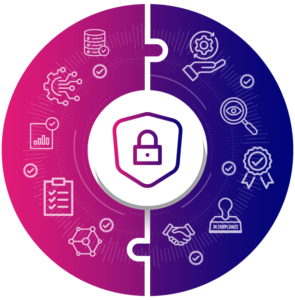
A mature privacy program has two distinct jobs, and they require different things.
The first job is managing compliance: tracking your data inventory, assessing risks, operationalizing policies, handling data subject requests, and maintaining documentation. This is the internal work of the program; the day-to-day machinery that keeps things running.
The second job is demonstrating compliance: providing external, credible, verifiable evidence that the work you’re doing internally actually meets the standard it’s supposed to meet. This is the job that faces outward to regulators, to enterprise buyers, investors, and to your board.
Software handles the first job well. The TrustArc platform, with solutions like PrivacyCentral, Nymity, and Trust Center, exist precisely to operationalize that internal work; to centralize data mapping, automate assessments, track obligations across jurisdictions, and give privacy teams the infrastructure to manage compliance at scale.
But software can’t do the second job. No internal platform, no matter how sophisticated, can independently validate that your program actually meets the standards it thinks it meets.
Evaluating your own compliance is not a flaw; it is how every mature program operates. The gap is not in doing that work. It is in stopping there. Independent certification picks up where internal assessment leaves off, turning operational confidence into externally verifiable evidence.
This is the gap that most established privacy programs have quietly accumulated: strong internal operations, with no external proof layer to show for it
THE GAP BETWEEN “WE’RE COMPLIANT” AND “HERE’S THE PROOF”
When a regulator investigates, when an enterprise buyer sends a security questionnaire, when your board asks whether the company can withstand scrutiny; the answer “we have a privacy program and we believe it’s compliant” does not close the conversation. It opens it.
Regulators and enterprise customers want to see accountability frameworks, documented assessments, evidence of ongoing management, and increasingly, independent validation. In the EU, the European Data Protection Board’s 2026 Coordinated Enforcement Framework is focused specifically on transparency and documentation obligations, and GDPR’s lower fine tier, covering gaps like missing records of processing, inadequate DPIAs, and undocumented DPO appointments, reflects exactly how seriously regulators treat this kind of procedural failure.
In California, CalPrivacy’s February 2026 settlement with PlayOn Sports required the company to conduct dated, documented risk assessments going forward as part of its remedy. New CCPA rules go further still, requiring qualifying businesses to have cybersecurity audits performed by an independent, qualified professional which can be internal or external, and certified annually. Enterprise buyers, especially those subject to their own compliance requirements, need to verify vendor practices before they can approve procurement. The standard for proof has risen considerably, and self-attestation meets less of it with each passing year.
This is exactly where regulatory risk and deal risk live: in the space between what you know internally and what you can demonstrate externally. Organizations that have invested heavily in their privacy operations (sometimes for years) can still find themselves exposed here because it has never been independently certified.
For many customers that use solutions like PrivacyCentral, Nymity, and Trust Center, this is a genuine blind spot. The operational side of the program is strong. The external proof layer simply doesn’t exist.
HOW TRUSTE CERTIFICATIONS CLOSE THE LOOP
What makes TrustArc’s position distinct is that it pairs compliance software with something software alone cannot provide: independent, third-party certification that gives your program external credibility. You get the infrastructure to manage compliance and the validated proof to stand behind it.
The platform side (e.g.PrivacyCentral, Nymity, Trust Center) handles the management layer. Assessments run continuously. Data inventories stay current. Obligations are tracked as regulations evolve. The program has operational integrity.
The TRUSTe certification side provides the external validation that the management layer alone cannot. TRUSTe has been the benchmark for independent privacy certification for over two decades. When your program carries TRUSTe certification, backed by annual reviews and ongoing support from TrustArc’s Global Privacy Managers (GPMs), you’re continuously monitoring your program and generating independently verified, third-party proof.
Together, these two layers create the closed loop that true continuous compliance requires.
For organizations managing traditional privacy compliance, data subject rights, consent management, cross-border data transfers, regulatory frameworks like GDPR and CCPA, pairing PrivacyCentral, Nymity, or Trust Center with TRUSTe’s Certification offering connects your operational work directly to certification-level rigor. Your assessments, your documentation, and your practices are evaluated against the standard, not just tracked against it.
For organizations building or scaling AI governance programs where the regulatory landscape is evolving rapidly and buyer scrutiny is intensifying, pairing your existing TrustArc platform with Responsible AI gives you the same closed-loop model applied to AI risk. You’re not just documenting AI systems; you’re operating and demonstrating a program that meets emerging accountability requirements before those requirements fully crystallize into enforcement.
In both cases, the architecture is the same: software that operationalizes the program, certification that validates it externally, and GPM expertise that keeps it continuously aligned as the environment changes.
THE QUESTION WORTH ASKING NOW
If your privacy program has strong operational infrastructure but hasn’t been independently certified, you’re managing the first job and leaving the second job undone. Or if your program has clear compliance gaps, an audit by a GPM will spot them and create a roadmap to continuous compliance.
That gap may not feel urgent on a quiet day. It becomes very urgent when a regulator opens an inquiry, when an enterprise deal stalls in vendor review, or when your board asks the question that operational dashboards can’t answer: can you prove it?
The organizations that will handle those moments well are the ones that built the external proof layer before they needed it, as a standard feature of how their program operates.
This is what it means to be continuously compliant: that you’re prepared for the next question, whoever asks it.
Ready to Close the Loop?
If you’re already using PrivacyCentral, Nymity, or Trust Center and haven’t yet connected your platform to external certification, TRUSTe’s Certification is the natural next step.
Turn Your Program Into Proof