


OneTrust has several major competitors. Many of them are specialized competitors, such as Ketch, Usercentrics, Osano, and DataGrail. But OneTrust offers a broad GRC-focused stack that is nevertheless difficult to use and hard to learn.
That is why TrustArc is often OneTrust’s closest competitor in terms of comprehensive software solutions and services. With over 28 years in the privacy industry, TrustArc is known as a privacy pioneer with a user-friendly, end-to-end platform, in-house expertise, certifications, and strong customer support.
TrustArc is the stronger overall choice and OneTrust’s strongest competitor.
Why consider any OneTrust competitors?
Most buyers start with OneTrust due to its market dominance and its platform that combines privacy, compliance, risk management, and third-party oversight across multiple regulations.
However, customer reviews, industry reputation, and our internal experience narrow down the reasons for switching to a few:
- OneTrust is expensive over the long run, especially with its history of price hijacking with renewals
- Lengthy implementations slow support responsiveness
- Privacy expertise and partnership, not just tooling
A recent review in Capterra mentioned, “Core modules often come at a premium, and costs escalate quickly as you scale or expand use cases.”
A senior growth manager said on Capterra, “Implementation was too difficult when we decided to add an automated CCPA form and had to switch to another vendor.”
Another 2025 review on TrustPilot said, “the customer support team is woefully slow.”
In summary, teams switch from OneTrust to alternatives, especially TrustArc, because they want less configuration, more ease of use, and more built-in expertise. For a side-by-side breakdown, see our TrustArc vs. OneTrust comparison.
Why do some teams prefer TrustArc to OneTrust?
OneTrust is well known for a broad focus on GRC, risk, security, and ESG. It is especially strong in data discovery. Its large ecosystem of partners (IAB Diligence Platform, Snowflake) also extends its broad footprint.
However, teams prefer TrustArc because it was founded in 1997 and has innovated at every turn of the evolving privacy industry. Its innovations include:
- First to create privacy risk management tools
- First government-recognized Accountability Agent
- One of the first end-to-end privacy program management software
This experience has given TrustArc the opportunity to build broad credibility among many companies. It combines privacy software, Nymity Research regulatory intelligence, certifications, and Managed Services for accountable, enterprise-scale privacy programs.
This competitiveness is reflected in trusted customer review sites like G2.
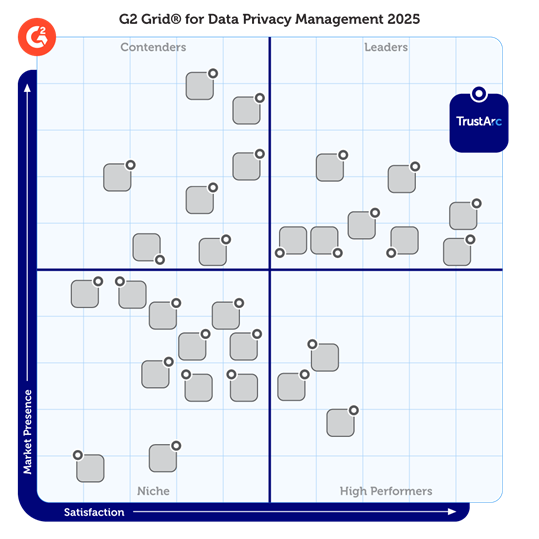
TrustArc vs OneTrust on the G2 Grid 2025: TrustArc recognized as a Leader in privacy management software.
Customers consider TrustArc for the following reasons:
1. Platform focus and breadth
TrustArc’s platform is privacy-first. It blends regulatory intelligence, automation, and AI to orchestrate end-to-end data privacy and governance. The Global Privacy Benchmarks Report 2025 shows that the majority of privacy professionals want an “overall data privacy management platform” that combines several features, which TrustArc excels at.
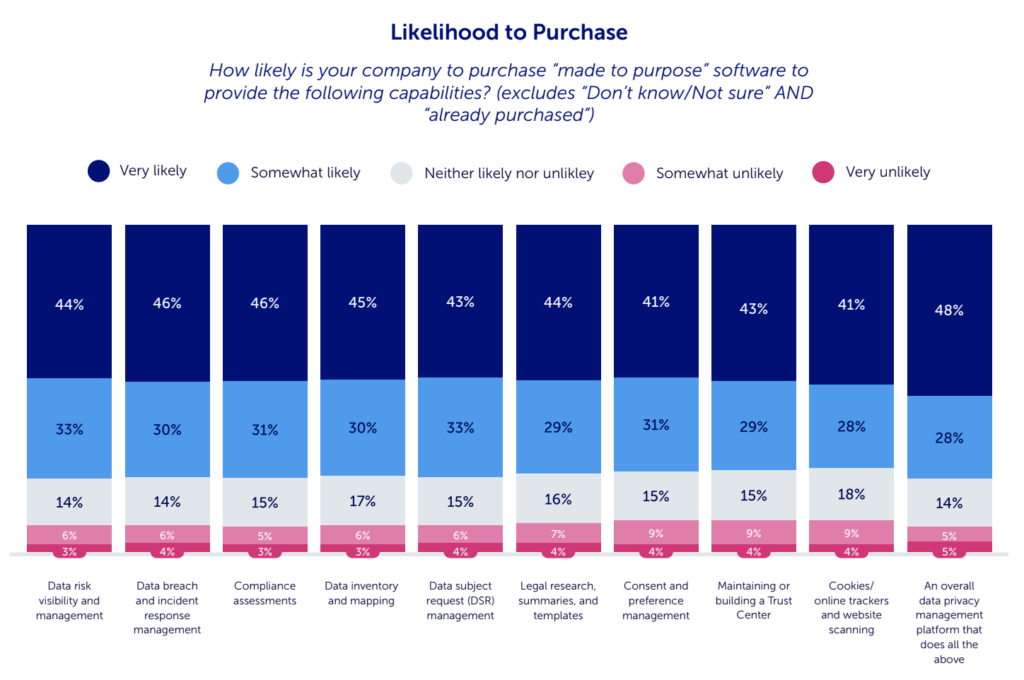
Global Privacy Benchmarks Report 2025 showing how likely companies are to purchase specialized privacy with various features.
Functionality includes:
- Cookie consent management
- Compliance monitoring, benchmarking, and evaluations
- Privacy and risk assessments
- Data mapping and risk management
- DSR management
- Privacy research, regulatory summaries, and operational templates
- Consent and preference management
- A transparent Trust Center
For a deeper product perspective, TrustArc offers some capabilities that OneTrust falls short on. For instance, PrivacyCentral offers comprehensive functionalities like 130+ standards, common controls, AI evidence analysis, multi-jurisdictional compliance automation, and benchmarking capabilities. OneTrust’s equivalent is more focused on security and fewer standards (approx 25+). Further, it doesn’t provide features like common controls, an AI evidence analysis, and attestation reporting.
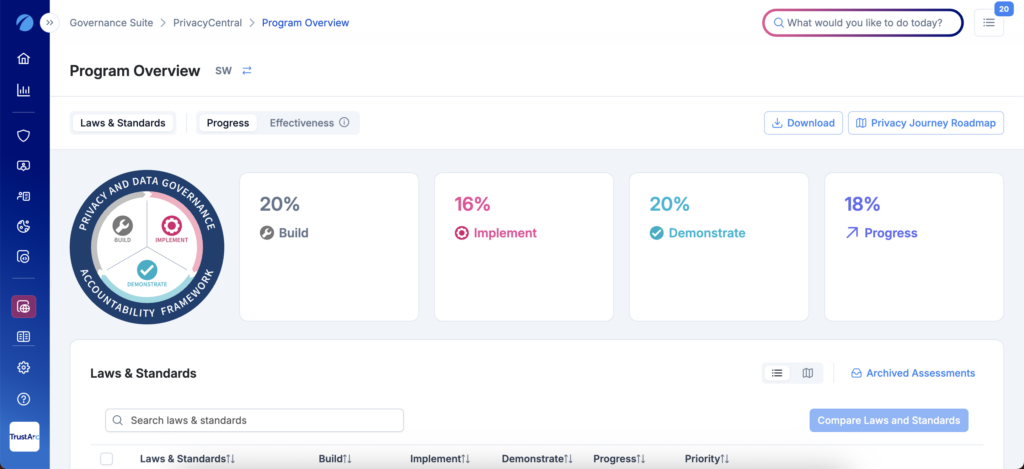
PrivacyCentral provides robust functionalities for compliance and Assurance.
Other features like TrustArc’s Data Mapping & Risk Manager (DMRM) and Assessment Manager
(AM) provide clearer residual risk reporting, data mapping to jurisdictional risks, assessment automation, and more.
With its Integrations, TrustArc offers a new, no-code platform that connects to over 300 business systems and provides expert-designed, pre-built templates to automate high-impact privacy workflows.
Customers agree that TrustArc provides robust privacy tools. A G2 customer in Information Technology and Services said, “I really enjoy how easy it is to track action items issued to us, so we can identify any privacy actions that must be taken and when they must be taken.”
2. Ease of use
One of the strongest ways TrustArc is a competitor to OneTrust is its ease of use, and that gap has widened significantly with newer launches.
TrustArc’s platform ease-of-use
Nishant B., an Information Security Officer on G2 said of TrustArc, “The platform’s intuitive dashboards and automation workflows make it easier to assess compliance against frameworks like GDPR, CCPA, and other global privacy regulations.”
This ease of use has several downstream effects, including:
- Faster onboarding for privacy teams.
- Less reliance on consultants to “make the tool usable.”
- Clearer workflows for DSRs, consent, assessments, and vendor risk.
This ease of use is now complemented by TrustArc’s broad range of applications. Its integrations connect your TrustArc account to more than 300 popular business systems. Integrations are no-code, and the drag-and-drop UI makes them accessible for everyday users.
Arc: The usability leader among OneTrust competitors
While OneTrust has been praised for its robust feature set, including incident management, notice management, and agentic AI, its hard-to-use interface makes it difficult to use, especially during onboarding.
A G2 review said, “There are needs [sic] to simplify the interface as it appears more complex in cases where individuals lack IT skills.”
TrustArc’s advantage in usability has only been extended further with the introduction of Arc. It is the next generation of the TrustArc platform, making it even more user-centric, AI-enabled, and privacy-first than before.
It’s not a separate product. It is available to all customers at no additional cost and with no forced migration.
All existing TrustArc applications seamlessly integrate into Arc, providing cleaner user interfaces.
Arc allows teams to:
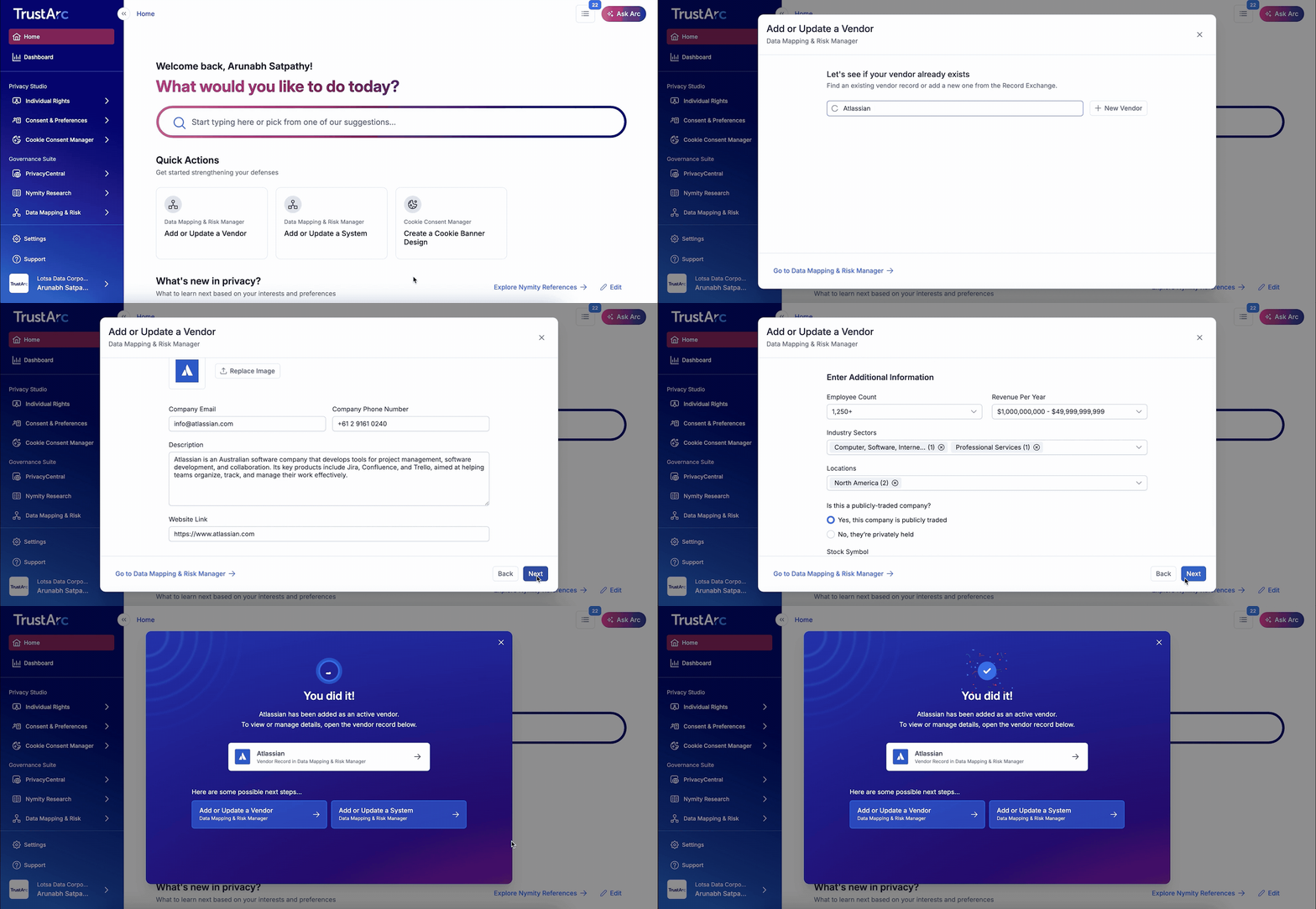
- Optimize for the day-to-day, streamlining workflows and elevating key actions. For instance, Quick Actions breaks down common privacy tasks into bite-sized steps to complete and move on.
- Focus on what matters by staying on top of required actions, risks, or tasks. Specifically, a modernized navigation on the left allows you to quickly access all TrustArc applications and solutions.
- Boost your team’s productivity. Notably, the all-new command bar allows you to go to the right place or ask questions without the need to guess where to click. Destinations include tasks, Quick Actions, research, or the correct TrustArc application.
- With the Unified Evidence Library, the TrustArc platform now provides a single source of truth for documents and records, offering user-controlled AI access. Users can also manually upload documents or links. The Evidence Library eliminates duplicate work, enforces consistency, and improves data security.
By comparison, while OneTrust does have AI agents, it still requires you to hunt for the right app and look through the documentation to understand specific workflows.
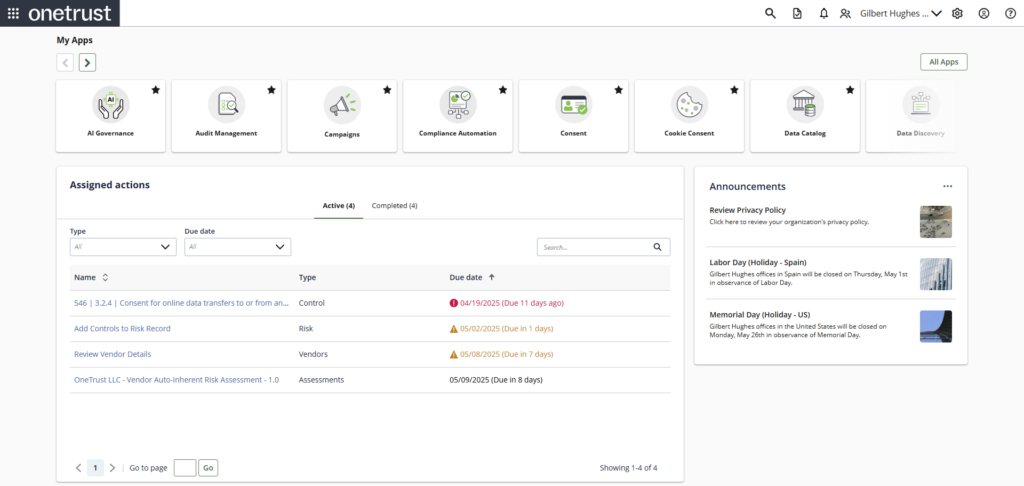
3. Arc Intelligence: TrustArc’s AI differentiator
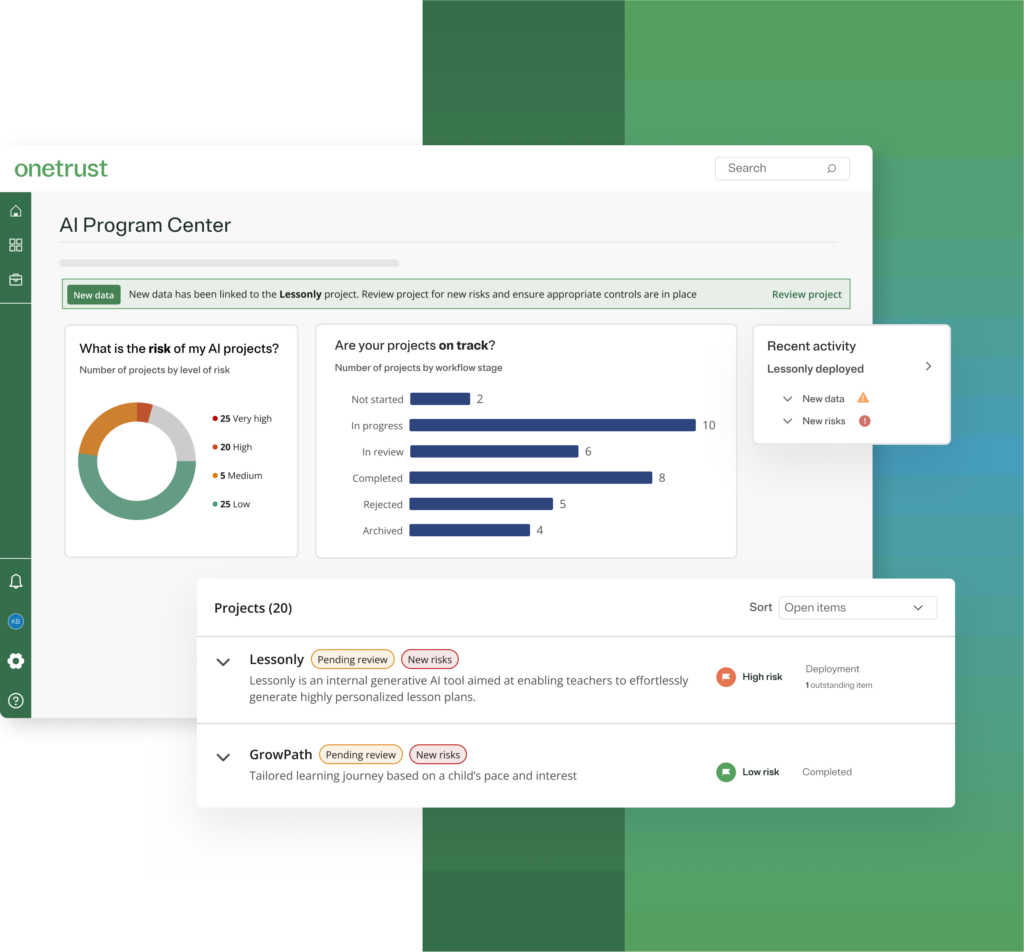
Both OneTrust and TrustArc have adopted AI into their platforms. However, their approach is very different. OneTrust has multiple AI agents scattered across the platform.
Onetrust’s AI integrations include regulatory research and bots like the Privacy Breach Response Agent across consent, DSARs, risk assessments, and evidence management.
Why Arc Intelligence is different
TrustArc’s approach to privacy management is more unified, focused on a better user experience across the board.
Arc Intelligence is the underlying technology that fuels automation across the TrustArc applications. It is not a generic chatbot. Its output is based on TrustArc’s 28+ years of privacy expertise, Nymity Research (1,000+ laws, 50,000+ references, daily updates), and live customer program data.
Unlike most privacy AIs, it is transparent by design, giving you cited answers, explainable logic, and full traceability. As a purpose-built AI fed by domain-specific data sets, it’s less likely to hallucinate and produce the kind of errors that general-purpose LLMs generate.
Throughout the process of using Arc Intelligence, customer data is never used to train AI models, per the TrustArc Terms of Use for Artificial Intelligence.

Arc Intelligence isn’t a “privacy chatbot.” It’s the underlying safe, unified, and embedded tech to power your privacy workflow.
Here are some examples of Arc Intelligence abilities:
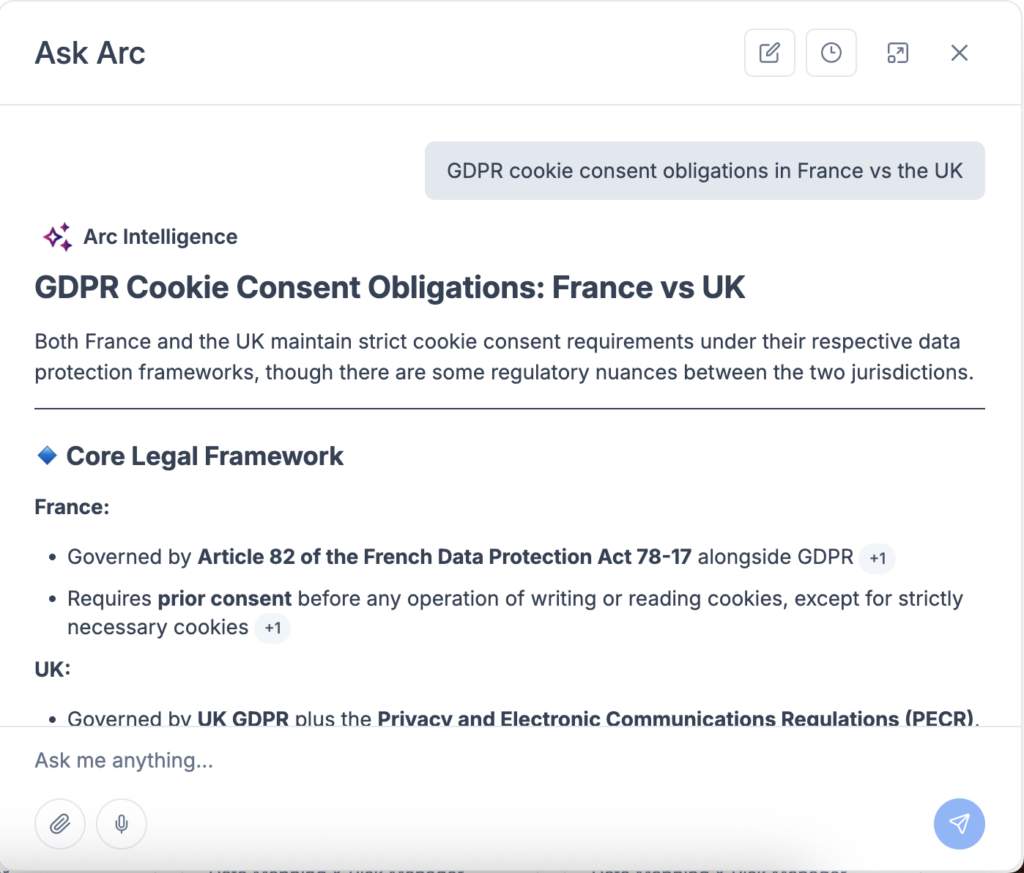
- Ask Arc is an intelligent privacy assistant you can invoke from anywhere on the platform. It responds to natural language AI questions and gives contextual and cited answers grounded in TrustArc’s in-house privacy research team, which publishes three to four new references and updates daily.
For instance, Ask Arc explains “GDPR cookie consent obligations in France vs. the UK. with Nymity citations and program context.
- Quick Actions: This breaks common privacy jobs into bite-sized steps to simplify common privacy workflows. For instance, you can complete a vendor update or cookie banner setup in a few guided steps, rather than deep menu navigation.
- Context-aware AI automation: Throughout your workflow, Arc Intelligence suggests autofill, classification, translation, and recommendations based on context.
Here’s what early users are saying about Arc Intelligence:
“This AI enhancement has transformed automation from a rigid process into something interactive and intuitive.”
Dominika Partelova, Senior Counsel and Global Data Protection Officer at Edgewell.
4. Accountability and recognized Certifications
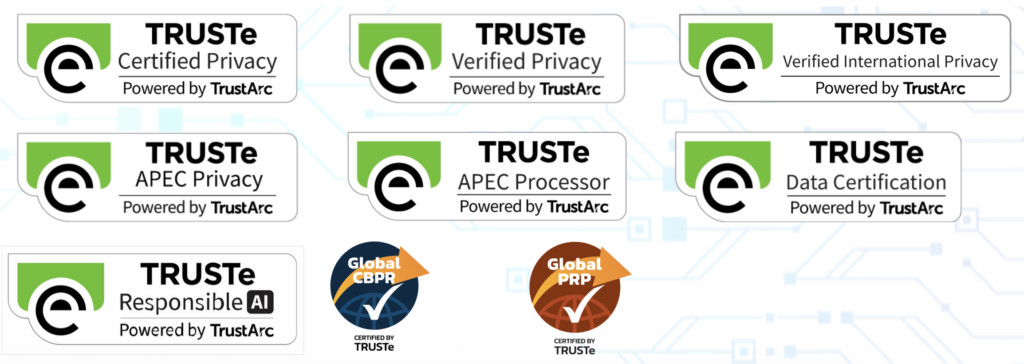
One of TrustArc’s unique advantages over OneTrust and other alternatives is its broad and deep assurance and certification services. TrustArc Assurance Services provides independent, formal attestations to verify compliance with global privacy regulations, reducing risk and building trust.
OneTrust provides individual certifications through GRC & Security Assurance Cloud, which supports 35+ frameworks and professional training/certification programs.
However, TrustArc offers assurance services, superior formal certifications, legal mechanisms for data transfers (like DPF and CBPR), audit readiness, dispute resolution, and specialized privacy assurance. TrustArc is also a certification pioneer, as the first U.S. Accountability Agent (and the first worldwide) to certify companies under the APEC Cross Border Privacy Rules (CBPR) system.
Key benefits:
- Demonstrating regulatory adherence and enabling cross-border data transfer
- Reduce risk and build trust with customers and partners
- Enable cross-border data transfer mechanisms
- A globally recognized TRUSTe Seal
- International privacy expertise and dispute resolution
- Conduct your certifications within TrustArc’s platform
Ready to build trust? Get Certified with TrustArc Assurance
5. TrustArc pricing and renewals transparency
As overall cybersecurity costs rise, renewal costs are increasing as well. Unfortunately, renewal costs can grow faster than overall IT budgets. With high switching costs for expensive cybersecurity software, security leaders feel compelled to accept increases to avoid being blamed for future incidents.
In such an environment, having predictable pricing and modest, consistent renewals can be a big boon for companies using cybersecurity software.
Unfortunately, OneTrust is well known for unexpected price increases. A Reddit comment calls it “Par for the course with OT.” A G2 comment said, “Some users may find the pricing model a bit opaque — costs can add up quickly as you add more modules or scale usage across departments.”
According to Forrester, OneTrust is also known for charging extra for implementation sessions.
6. Support and services
Poor customer support and service lead to 14% of customer churn. This churn can be at any stage where customer support is involved, including onboarding, adoption, retention, or product expansion.
While OneTrust is well known for having comprehensive software, its hard to use nature also necessitates frequent requests to customer services. And this service is often hard to access because of:
- Tiered support packages: OneTrust limits the quality of support you can access to priced tiers (Essentials, Plus, Premier/Signature), which add to the overall cost. Essentials and Plus offer self-service options and don’t offer 24/7 support.
- Limited dedicated customer success: This service is available only with the Premier or Signature support packages.
By comparison, TrustArc positions offers integrated and expert-led service across the customer base, including:
- Standard 24/7 technical support available as part of platform access
- Extensive self-service options, including documentation, knowledge base, guided help videos, etc.
- Arc Intelligence can teach customers how to use their tools in situ.
- Dedicated Technical Account Managers for all Cookie Consent Manager Advanced customers.
Get a live walkthrough of how TrustArc supports you in real-world scenarios
How to migrate from OneTrust to TrustArc
The best time to migrate from OneTrust to TrustArc is now. With the launch of Arc, the benefits of a better overall experience and superior customer service, here is a clear six-step migration path to TrustArc.
| Stage | Goal | Key activities |
| 1. Discovery | Assess existing data and compliance requirements, and define the project’s scope and timing. | TrustArc’s CSI team works with your team to identify data types, workflows, and compliance requirements. Your team provides sample data extracts (e.g., ROPA, DSARs). |
| 2. Plan your project | Develop a migration game plan and timeline. | TrustArc assigns timelines and priorities. Both TrustArc and your team assign specific roles and responsibilities. |
| 3. Configure | Prepare the TrustArc system for data import and set up application configurations on our end. (e.g., Data Mapping & Risk Manager, Assessment Manager). | TrustArc configures fields, workflows, and aligns OneTrust data with TrustArc’s mapping. |
| 4. Import | Move data from OneTrust to TrustArc without loss or corruption. | TrustArc’s Data Migration team manages the extraction, mapping, and uploading of data, executing the full migration in phases. |
| 5. Test & validate | Ensure migrated data is accurate and that system functionality remains intact. | The client reviews the imported data to align with the agreed-upon requirements, and any issues are identified and resolved before full migration. |
| 6. Launch | Deploy TrustArc into full production and ensure a smooth transition. |
Ready to switch?
Let’s migrate from OneTrust togetherFAQ (People also ask)
1. Who are OneTrust’s competitors?
OneTrust has several competitors in consent and data privacy management space, including TrustArc, Usercentrics, Osano etc. TrustArc is the most direct competitor, which enterprises may prefer for its ease of use, in-house privacy intelligence, Arc Intelligence, and excellent support.
2. Is TrustArc easier to implement than OneTrust?
Yes, with its guided workflows, dedicated implementation support (especially TAMs), TrustArc is easier to implement than Onetrust.
3. What features should a OneTrust competitor have?
A strong OneTrust alternative requires a privacy focused, user friendly, and end-to-end platform with transparent AI and superior customer support.
4. Who owns TrustArc?
TrustArc is owned by Main Capital Partners. The acquisition focused on global expansion and product investment, compounding the benefits of Arc into a new generation.
5. Is TrustArc AI safe?
The TrustArc platform is designed with your privacy first. It uses enterprise-grade security controls, including SOC 2 Type II audits, strong encryption (in transit and at rest), role-based access controls, SSO/2FA, secure cloud infrastructure, and strict data-use policies.
For more information on overall security, visit our TrustCenter.
Customer data is never used to train AI models. For more information, read the TrustArc Terms of Use for Artificial Intelligence.

Intelligent Automation. Global Compliance.
Meet global regulatory obligations without the manual grind. Leverage 20,000+ pre-defined controls mapped across 125+ laws to minimize redundant work and turn complex requirements into a streamlined, automated advantage.

Visualized Flows. Managed Risk.
Save time and reduce exposure with automated data flow mapping and intelligent risk analysis. Generate on-demand compliance reports and audit trails to navigate cross-border data with absolute confidence.